How Objects Carry Memories In Our Lives & Shape Our Emotions
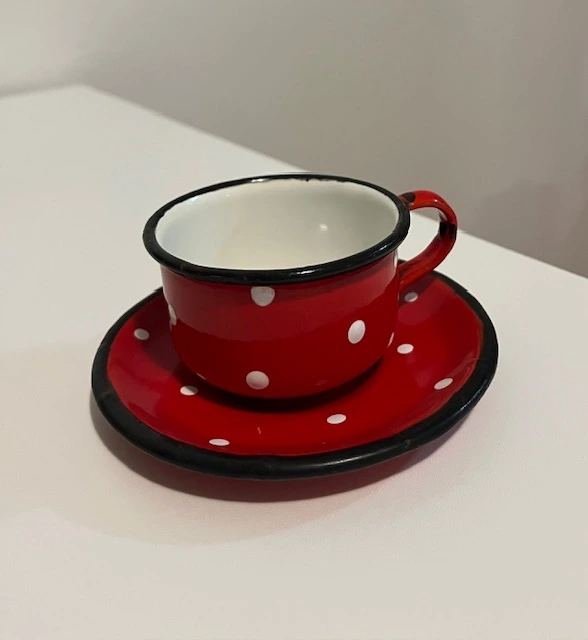
There is a small Hungarian espresso cup that sits in my office.
It is enameled iron, simple, and looks like a toy cup, polka dotted, funny, a miniature of an old cooking pot. I brought it with me across countries and across time. It carries something much more than coffee.
My mother brought a set of six home after visiting a factory in Hungary. I loved them immediately. As an enthusiastic coffee drinker, I used them often, at home, with friends, with my grandmother, during long hours of reading, writing, and thinking through university life.
Over time, something quiet and powerful happened.
The cup became associated with being at home.
Not a perfect home, no one’s is, but one that held enough warmth, connection, and life. Somehow, those moments gathered themselves around the cup. The laughter, the conversations, the solitude that felt full rather than empty. The ordinary, meaningful rhythms of living.
And interestingly, the difficult parts of life, did not “enter” the cup in the same way.
How Objects Carry Emotional Memory
In psychology, we understand that memory is not stored as a single, fixed event. It is a network, of sensations, emotions, images, and meanings.
Over time, these networks organise themselves.
The coffee cup became a kind of anchor point in that network. A visual and sensory cue that links to repeated experiences of warmth, connection, and a sense of being whole.
So now, when I see it in my office or hold it in my current home, something happens almost instantly. There is a gentle shift inward, toward familiarity, continuity, and emotional warmth.
Not because the cup itself is special, but because of what has been woven into it.
Memory Reconsolidation in Everyday Life
We often think of memory as something fixed in the past. But it is not.
Every time we revisit a memory, it becomes briefly “open” and can be updated before it is stored again. This is the essence of memory reconsolidation.
What is remarkable is that this process doesn’t only happen in therapy. It happens in everyday life.
Each time I use this cup and feel that quiet, warm, “being whole” state, that emotional memory is strengthened. The network becomes more stable, more accessible, more alive.
The cup is no longer just a container of past experiences.
It becomes an active participant in shaping present emotional experience.
The Cup That Was “Saved” for Guests
I have another espresso cup from my mother.
This one lived in a cabinet. It was reserved for guests, used carefully, intentionally, and with a certain kind of reverence.
Now it sits in my home.
Interestingly, it carries something slightly different.
It seems to hold only the nurturing, holding, neat, and safe aspects of those earlier experiences. The mind, in its own quiet way, has filtered what belongs there. What remains is a distilled sense of care, safety and warmth.
Almost as if different objects can hold different emotional “themes” from the same life.
The Fairytale and the Ordinary
The first cup holds something layered:
- a touch of childhood fairytale
- the vividness of youth
- the groundedness of present life
It is both ordinary and symbolic.
And perhaps this is something we all carry, objects that quietly hold our continuity. Not because life was perfect, but because it was alive enough, connected enough, meaningful enough for warmth to take root.
Most people have something like this.
A cup. A book. A piece of furniture. A smell. A place.
Something that, without effort, brings a shift in the body, a softening, a sense of familiarity, a feeling of “this is me” or “this is home.”
These are not trivial.
They are part of how the mind organises experience and preserves what is good.
And importantly, they can be used intentionally. Returning to them, noticing the feeling they evoke, allowing that state to deepen, this is one of the simplest ways to strengthen emotional wellbeing over time.
Closing Thought
This small Hungarian coffee cup sits in my office.
To others, it is just an object.
To me, it is a quiet repository of lived experience, of warmth, connection, and continuity across time.
And each time I use it, those qualities become just a little more present, a little more accessible. I still love coffee.