Artificial Intelligence (AI) is rapidly becoming part of everyday life. From navigation apps to online customer service, AI tools are now woven into many professions, including psychology.
While some people feel excited about the possibilities, others worry that technology may replace the deeply human aspects of therapy. In reality, AI is more likely to become a supportive tool within psychological practice rather than a substitute for genuine therapeutic relationships.
How AI supports my practice
In my practice AI at times serves as administrative support – I spend less time with editing letters, reports, organising appointments.
AI tools can help to create educational material, self-help kits for clients.
Clients often benefit from clear written explanations about anxiety, trauma, depression, nervous system regulation, or coping strategies.
I often recommend appropriate Apps, online tools for home practice, or discussions.
Some apps can guide users through mindfulness exercises, mood tracking, breathing practices, journaling prompts, or cognitive behavioural strategies between therapy sessions. For some people, these tools may increase self-awareness and encourage regular emotional reflection. They can be particularly useful for reinforcing therapeutic work outside the consulting room.
When clients bring AI conversations to therapy
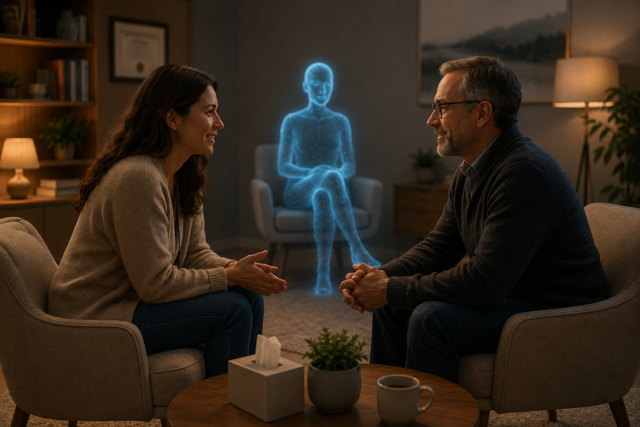
When my clients consult AI about their issues, emotional states, I like to encourage them to bring their conversations to sessions, so in a way they have a three person discussion, and a conversation becomes deeper and more personal. I enjoy working with AI ‘assistants’ that way. Of course, clients’ curiosity and willingness is essential for this type of interaction, and I absolutely understand that we all have different opinions about consulting AI about our private affairs.
AI also has significant limitations, particularly in psychotherapy. Therapy is not simply the delivery of information. Healing often emerges through human connection, emotional resonance, trust, attunement, empathy, and the experience of being genuinely understood by another person.
AI cannot truly “feel” emotional nuance, perceive subtle interpersonal dynamics, or intuitively understand the lived emotional world of a client in the way a skilled therapist can.
Why the therapeutic relationship cannot be replicated
In trauma therapy especially, safety and relational connection are central. Many clients carry histories of emotional neglect, betrayal, abuse, or attachment disruption. The therapeutic relationship itself often becomes part of the healing process. While AI may assist with certain practical tasks, it cannot replace the depth of human presence that supports emotional repair.
There are also important ethical considerations. Confidentiality, privacy, data security, and informed consent remain critical issues when using AI-related technologies in healthcare settings.
The Australian Government has developed guidelines around AI ethics that highlight the importance of transparency, fairness, and privacy in AI applications.
The risks of over-reliance on AI
Another concern involves over-reliance on automated systems. AI generates responses based on patterns in data, not genuine wisdom or clinical judgement.
The Australian Psychological Society emphasises that clinical decision-making does require human expertise, particularly when workingwith complex psychological situations.
It may occasionally produce inaccurate, superficial, or misleading information.
That is why I strongly recommend my clients sharing their interactions with AI, so they are safer in the process. Psychological formulation requires careful understanding of personality, history, culture, relationships, trauma, risk factors, and emotional meaning, areas where human clinical reasoning remains essential.
There is also a broader social question emerging around AI and emotional life. As society becomes increasingly digital, many people already experience loneliness, disconnection, and emotional overstimulation.
The value of authentic human relationships may become even more important in the years ahead. Psychology practices may therefore serve not only as places of treatment, but also as spaces where genuine human attention and emotional understanding are preserved.
The future of AI in psychology
AI may become a useful assistant within psychology practices rather than a replacement for therapy itself. It can help reduce administrative strain, improve access to information, support organisation, and offer supplementary wellbeing tools. Yet the heart of psychotherapy remains profoundly human: two people engaging in a meaningful emotional conversation that allows reflection, growth, healing, and change.
Technology may continue to evolve rapidly, but the human need for connection, understanding, safety, and compassion is unlikely to disappear. In many ways, the growing presence of AI may remind us even more clearly of the unique value of authentic human relationships, including the therapeutic relationship at the centre of psychological care.